
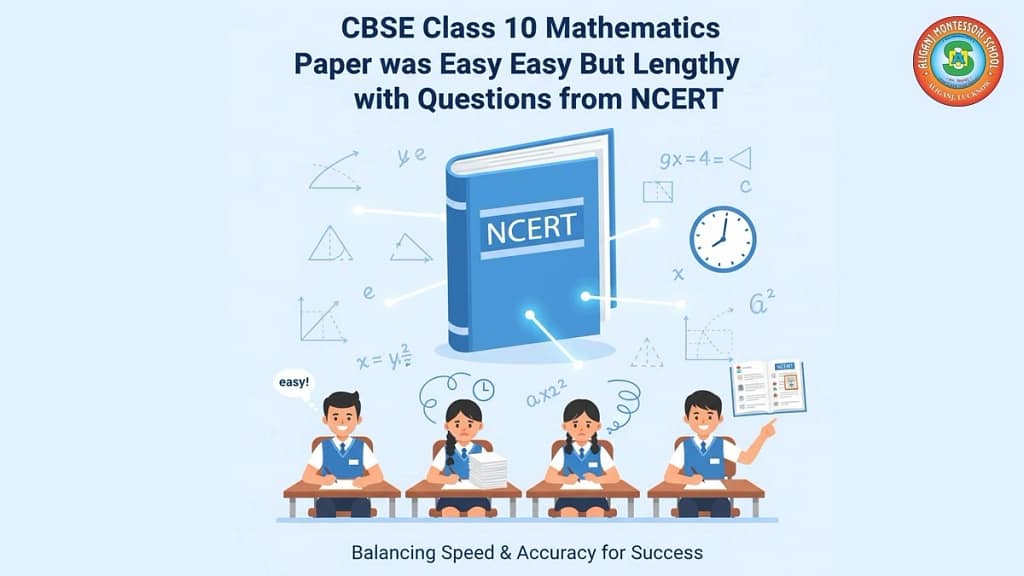

The 2025 edition of the CBSE Class 10 Mathematics paper stood out for one striking duality: it was relatively easy in terms of concepts but lengthy in terms of volume and time required. A lot of students realized that although they were familiar with the subjects (in a big way because of the syllabus taught in the NCERT Class 10 Mathematics book), maintaining the speed and finishing the paper within the allotted time was difficult. This article goes in-depth into this trend, breaks down why the paper seemed effortless but long, examines how many questions were actually from NCERT, discusses the implications for students, and provides actionable advice for future prep.
Table of Contents
Overview of the CBSE Class 10 Mathematics Paper
As per the CBSE sample and exam pattern issued officially, Class 10 Mathematics paper consists of 38 questions divided into five sections (A to E), with certain segments having internal choices.
The pattern, question types (MCQs, very short answer, short answer, long answer, case-based), and chapter-wise weightage are same.
Important pattern points:
- Section A: MCQs & Assertion-Reason (1 each)
- Section B: Very Short Answer (2 each)
- Section C: Short Answer (3 marks for each)
- Section D: Long Answer (5 marks for each)
- Section E: Case-based Questions (4 marks for each)
While the conceptual challenge of NCERT-aligned questions (rendering it conceptually “simple” for properly prepared students), the paper’s length — massive number of questions, sub-parts, and multi-step problems — was the aspect that caused pressure.
Why the Paper Felt Easy But Lengthy
Familiar Concepts from NCERT
Most students mentioned that the majority of questions were following the NCERT textbook almost or precisely. With good coverage by NCERT, such questions were “easy”. CBSE pattern and sample papers had focused on following NCERT.
Easy But In-Depth Questions
Though concepts were known—number systems, algebra, geometry, trigonometry, mensuration, statistics & probability—the manner of asking them involved more than one step or mixed parts, thus taking more time.
Time Management Was The Key
Due to the length—several questions, multiple sections, and combinations—students who just banked on conceptual knowledge without practice-time were finding it difficult to complete within time.
Case-based Questions Included
Section E’s case-based questions (4 marks each) were meant for interpretation, reading of scenarios, and application of several concepts. These contribute to “length” since they involve reading comprehension in addition to calculation.
Simple Scoring but Spread Out
Since the paper rewarded straight application of NCERT methods, scoring potential was good—but there were plenty of small questions instead of few big ones. This left less time to unwind between questions.
Evidence of NCERT Questions and Direct Usage
Both students and teachers noted that a majority of questions were repetitive or near-repetitive of NCERT Class 10 Maths exercises or exemplar problems. This benefited students who had studied NCERT well. Sources advise the use of previous year NCERT exemplar and sample papers for practice.
Some of the general trends noted are as follows:
- Direct simple questions from NCERT exercise problems
- Questions relating two subjects but based on NCERT examples
- Question phrasing reflected NCERT wording, downplaying conceptual freshness
Therefore, the paper gave more marks for material learning (i.e., complete command of the syllabus and NCERT material) than for “new trick” questions.
Implications for Students and Teachers
For Students
- Complete NCERT well: As a lot of questions were from NCERT, students have to learn NCERT textbook and exemplar questions.
- Time-practice is a must: Due to the duration, it is important to attempt full-length mock tests in 3 hours (or the time given).
- Study all chapters: Since the paper was drawn from all units (number systems, algebra, coordinate geometry, geometry, trigonometry, mensuration, statistics & probability) as per syllabus.
- Practice case-based questions: These will need to read and apply multiple concepts.
- Avoid “easy” complacency: Familiarity with concepts doesn’t mean the paper is short or easy.
For Coaches/Coaching Institutions
- Highlight time management as much as clarity of concepts.
- Take past NCERT exemplar questions as starting point and then multiply with multi-part/combined question papers to develop endurance.
- Prompt completion of timed full-paper mocks to replicate examination scenario.
- Train students to quickly go through the entire question paper, mark easier questions first, and allocate time across sections.
- Offer strategic revision of most weighty units (e.g., Algebra, Geometry) and complete coverage of all units.
Unit-Wise Weightage & Preparation Emphasis
Based on the syllabus division, the units and estimated marks are:
| Unit | Name | Marks |
| I | Number Systems | ~6 |
| II | Algebra | ~20 |
| III | Coordinate Geometry | ~6 |
| IV | Geometry | ~15 |
| V | Trigonometry | ~12 |
| VI | Mensuration | ~10 |
| VII | Statistics & Probability | ~11 |
Students should observe from this that Algebra, Geometry, Trigonometry have more weight. Since the paper was not difficult but long, lack of focused practice in low-weight units can mean time-wasting without benefit. Practice high-weight units, but do not ignore others.
Specific Tips for Approaching an “Easy but Long” Paper
- Read instructions and glance through all questions at the start—partition time.
- Shortlist questions you know—answer them first and mark long ones for later.
- Work on shorter questions first (MCQs, 2/3 mark ones) before tackling long ones.
- Monitor time per section—don’t waste too much time on one problem.
- In case-based questions, read scenario carefully, underline main info, map to formulas.
- Review and memorise key formulas and theorems—because the questions were straightforward NCERT style.
- Use final 15-20 minutes to go back to missed questions, verify calculations, and make sure there’s an answer for every one of them.
- Relax—because the paper was simpler conceptually, maintaining a consistent speed can achieve high marks.
Typical Errors Noticed: CBSE Class 10 Mathematics paper
- Solving one lengthy question to excess and running out of time for others.
- Not doing 1-mark and 2-mark questions because “they are easy”—resulting in missing marks.
- Failing to read case-based question carefully and wrong-interpreting the situation.
- Overlooking low-weight topics (e.g., Number Systems, Coordinate Geometry) just because they look small—yet all marks are important.
- Insufficient practice in full-paper timed format, leading to attempted incomplete solutions.
Planning for Future Board Exams: Strategy Ahead
As the CBSE paper pattern does not change and most questions repeat NCERT, the strategy for future board exams should be:
- Full NCERT: Do all exercises and exemplar problems.
- Periodic revision: Particularly formulas, theorems, and problem-solving techniques.
- Mock papers within time limits to replicate the length of the paper and time factor.
- Emphasize speed and correctness: Since concept level might be less, time is more of a differentiator.
- Provide last-minute practice with high-weight items and practice case-based type questions.
- Study previous year papers to detect patterns and types of questions that recur.
Frequently Asked Questions: CBSE Class 10 Mathematics paper
1. Was the CBSE Class 10 Mathematics paper easy or difficult?
The paper was found to be fairly easy in terms of concept—majority of the questions were aligned with NCERT—but long in terms of quantity of questions and sub-parts, so time management was crucial.
2. How many of the questions were straight from the NCERT textbook?
Exact figures aren’t printed, but several students and teachers opined that a good amount of questions were replicas of NCERT exercise problems or exemplar questions, and thus mastering NCERT was extremely useful.
3. Why was the paper long despite easy concepts?
Due to the sheer number of questions, numerous sub-parts, and case-based questions involving more reading and multi-step solution. The pattern focussed on breadth of coverage over high difficulty.
4. What must students do in light of this pattern?
Students must go through the NCERT textbook comprehensively, practice timed, focus on high-weight chapters (Algebra, Geometry, Trigonometry), and learn full-paper time strategy.
5. Unit-wise weightage for CBSE Class 10 Maths
Around: Number Systems (6), Algebra (20), Coordinate Geometry (6), Geometry (15), Trigonometry (12), Mensuration (10), Statistics & Probability (11).
Conclusion: CBSE Class 10 Mathematics paper
The CBSE Class 10 Math paper for 2025 achieved an unusual balance: conceptually within reach but intensely rigorous in terms of time and endurance. Well-prepared students who had internalized the NCERT textbook will find the “easy” description accurate. But the “lengthy” ordeal was painfully real.
In the future, students should pay more attention to being prepared, pacing, covering everything completely, and being intelligent in terms of strategy. These will be the things that distinguish good from great performances.
Ready to convert preparation to performance? At AMS, we specialize in preparing students for CBSE Class 10 Mathematics success. Our systematic programs, exhaustive mock tests, NCERT-matched practice modules, and time-management training prepare you to excel not only on the topics—but the entire paper.
Enroll with AMS today and get your board maths exam smoother, smarter and more successful.
Discover AMS Programmes | Contact AMS Team