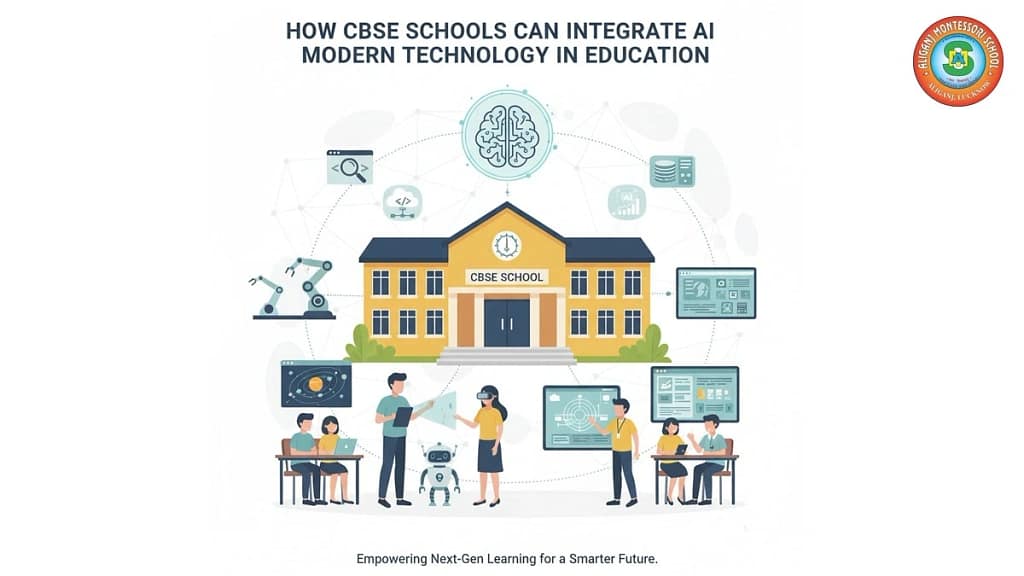

AI and Modern Technology in Education: Education in the 21st century is evolving faster than ever. The Central Board of Secondary Education (CBSE), one of India’s largest and most dynamic education boards, has recognized the importance of AI (Artificial Intelligence) and modern technology in shaping future-ready learners.
From AI-enabled learning modules to virtual classrooms, CBSE schools are shifting towards smart, data-centric, and personalized learning systems today. This is not about how to teach technology — it’s about how to use technology to better teach.
This article discusses how CBSE schools can adopt AI and contemporary technology in education, their advantages, implementation, challenges, and why this integration is essential for 21st-century learning excellence.
Table of Contents
Why CBSE Schools Should Adopt AI and New Technology
Future-Proofing the Students
We are in a world where AI, robots, data science, and automation are revolutionizing sectors. Schools have to future-proof the students for occupations that do not yet exist. Incorporating AI in CBSE education creates digital competency and future-readiness.
Personalised Learning Experience
AI enables CBSE schools to make learning according to the pace and capability of every student. Intelligent learning platforms examine student performance, pinpoint strengths and weaknesses, and suggest specific resources — developing a customized education environment.
Teaching Efficiency
Contemporary technology reduces clerical work, offers insights using data, and allows teachers to concentrate on constructive teaching and guidance instead of paperwork.
Urban-Rural Divide
Technology has the capacity to provide quality education to students in far-flung areas. AI-based e-learning platforms eliminate geographical barriers, making it inclusive.
Increasing Student Engagement
Engaging tools such as virtual labs, gamification of learning, and augmented reality render lessons interesting, relevant, and rememborable.
The Vision of CBSE Towards AI Integration: AI and Modern Technology in Education
CBSE has already made considerable progress towards integrating AI and digital learning.
Together with Intel, CBSE launched AI as a skill subject for students in Classes 8–12 to foster AI awareness and computational thinking.
The CBSE AI curriculum is centered on:
- AI concepts and applications
- Handling data and ethics
- Machine learning fundamentals
- Responsible AI for social good
- Hands-on projects with actual datasets
The program is under CBSE’s Skill Education initiative, which is in line with the National Education Policy (NEP) 2020, which focuses on technology inclusion and experiential learning.
Most Important Areas Where AI and New Technology Can Be Implemented
Smart Classrooms
Smart boards and digital projectors powered by AI facilitate real-time collaboration, interactive lectures, and multimedia instruction. Teachers can monitor activity, test feedback, and tailor activities.
AI-Powered Learning Platforms
Google Classroom, Byju’s, or CBSE Academic Portal, among others, employ AI-based algorithms to study learning patterns, offer insights, and improve knowledge retention.
Virtual Reality (VR) and Augmented Reality (AR)
VR/AR turns conventional teaching into interactive experiences. Students may visit planets outside the earth, explore a frog in biology class, or move through historic landmarks.
Data Analytics for Education
AI applications monitor and analyze data from tests and attendance in order to give feedback regarding student performance and emotional health.
AI in Administrative Functions
AI automates attendance, report cards, and communication, freeing time for educators and minimizing human error.
Chatbots and AI Assistants
AI chatbots are able to respond to student questions, assist with homework, and give feedback around the clock — building a 24/7 learning system.
Robotics and Coding Labs
CBSE’s STEM and Robotics focus promotes experiential learning. Robotics labs introduce students to problem-solving, reasoning, and collaboration.
Digital Examinations
AI-powered test scoring systems are able to mark answer sheets, identify plagiarism, and minimize errors in exams — making exams fair and transparent.
Benefits of Integrating AI and Modern Technology in CBSE Schools
Improved Learning Results
AI provides adaptive learning and customized content, resulting in improved understanding and retention.
Application of Knowledge in the Real World
Students receive practical exposure through projects, coding, and real-life simulations, connecting academic knowledge to real-world abilities.
Accessibility in Learning
AI tools support differently-abled students by voice commands, screen readers, and adaptive devices, ensuring inclusive education.
Empowerment of Teachers
Upgraded tools assist teachers with analytics, lesson-planning, and classroom management, enabling them to concentrate more on mentorship.
Enhanced Student-Teacher Interaction
Cloud platforms enable collaboration beyond classrooms — teachers can mentor and students can learn anywhere, anytime.
Cost Savings and Efficiency
Automation minimizes manual effort, operational expenses, and time, enabling schools to make the best use of resources.
CBSE School Steps Towards Implementing AI and New Technology
Step 1: Development of Infrastructure
Schools need to develop digital infrastructure — robust internet, smart devices, projectors, and secure data systems.
Step 2: Training and Upskilling of Teachers
Educating teachers is essential. Workshops, certification courses, and modules for digital literacy equip teachers to effectively employ AI tools.
Step 3: Implementation of AI Curriculum
CBSE has made AI an elective subject. The school should integrate it as a core skill subject to foster AI literacy across classes.
Step 4: Application of EdTech Tools
Integrate learning management systems (LMS), online assessment tools, coding platforms, and AI-supported study materials.
Step 5: Collaborations and Partnerships
Schools may collaborate with AI education providers, technology firms, or NGOs to gain access to sophisticated tools, curriculum enhancements, and mentorship.
Step 6: Promote Student Projects
Students must use AI and technology to address actual community issues — encouraging innovation and critical thinking.
Step 7: Periodic Assessment
Track the effectiveness of the integration with students’ feedback, data analysis, and performance monitoring.
Challenges in AI and Technology Integration: AI and Modern Technology in Education
Absence of Infrastructure
Most of the CBSE schools, particularly those in rural settings, do not have the facilities to integrate technology.
Teacher Training Gaps
If teachers are not properly trained, they might not be able to utilize contemporary technology effectively.
Cost and Maintenance
Smart infrastructure and AI software need investment upfront and maintenance costs on an ongoing basis.
Data Privacy and Cybersecurity
With digital systems, keeping student data secure and privacy intact are foremost concerns.
Resistance to Change
Certain educators and parents might be resistant to adopting new teaching models.
Addressing them calls for policy support, training initiatives, and collaboration between schools, government, and EdTech firms.
The Future of AI in CBSE Education: AI and Modern Technology in Education
Predictive Learning Systems
AI will soon be able to foretell student requirements, suggest career choices, and tailor lessons for every student.
AI-Powered Examinations
Future exams will employ automated assessment systems that monitor student improvement beyond mere rote learning.
Gamified and Experiential Learning
Gamified AI systems will turn learning into an interactive, creative, and emotionally stimulating experience.
Virtual Teachers and AI Tutors
AI tutors shall support human teachers by responding to questions, tracking progress, and making recommendations for interventions.
Emphasis with NEP 2020
CBSE’s alignment with NEP 2020 shall ensure AI-driven innovation, interdisciplinary learning, and skill-based education for every student.
How AMS Empowers CBSE Schools with AI and Modern Technology
AMS firmly believes that education and innovation go together. As a pioneering institution committed to future-readiness, AMS has been adopting AI tools, robotics labs, and digital classrooms in its network.
AMS’s integration of AI consists of:
- AI and Robotics Curriculum for classes 6 to 12
- Professional development programs for teachers in AI, coding, and digital pedagogy
- Smart classrooms with interactive boards and real-time analytics
- Student innovation labs for AI-based projects
- Emotional AI technology to monitor student engagement and happiness
AMS’s model proves that AI in schooling is not meant to replace educators but empower them to provide influential, personalized, and transformative learning experiences.
AI and New Technology FAQs in CBSE Schools
1. Why is the integration of AI crucial in CBSE schools?
Because AI personalizes learning, enhances results, and readies students for future careers that require digital and analytical skills.
2. What AI programs has CBSE initiated?
CBSE has made AI a skill subject from Class 8 and collaborated with Intel to develop a national-level curriculum for AI.
3. How can AI enhance learning in classrooms?
AI offers data-driven insights on student progress, suggests personalized learning resources, and automates standard tasks — making instruction more effective.
4. Is the cost of AI tools feasible for every school?
Many EdTech companies now offer low-cost AI solutions, and the government provides digital grants under NEP initiatives.
5. Can AI replace teachers?
No. AI complements teachers by handling repetitive tasks and providing analytics, allowing teachers to focus on creativity and human connection.
6. How can students benefit from AI integration?
Students gain problem-solving skills, exposure to real-world technology, and adaptability for future digital careers.
7. What challenges do CBSE schools face while adopting technology?
The primary issues are the cost of infrastructure, teacher digital training, and cybersecurity and data privacy.
8. How can CBSE schools begin integrating technology?
Begin small — starting with smart classrooms, coding sessions, and AI-based learning systems — and then scale up to full integration.
Conclusion: AI and Modern Technology in Education
The future of CBSE education is AI-driven, student-centered, and technology-powered. By incorporating artificial intelligence and contemporary technology, schools can reimagine classrooms as vibrant learning environments where creativity intersects with computation and data intersects with empathy.
AI is not a tool, but a learning partner that enables teachers to teach smarter and students to learn better.
CBSE schools that implement AI today are equipping their students not only for tests — but for life, innovation, and leadership in the digital age.
At AMS, we are revolutionizing education through AI adoption, digital disruption, and future-proof learning.
Our CBSE curriculum combines technology, imagination, and values to equip students for success in the age of AI.
Become a part of AMS today — where learning is intertwined with innovation, and students transform into tomorrow’s leaders.
Discover AMS CBSE Programs Reach AMS Team