
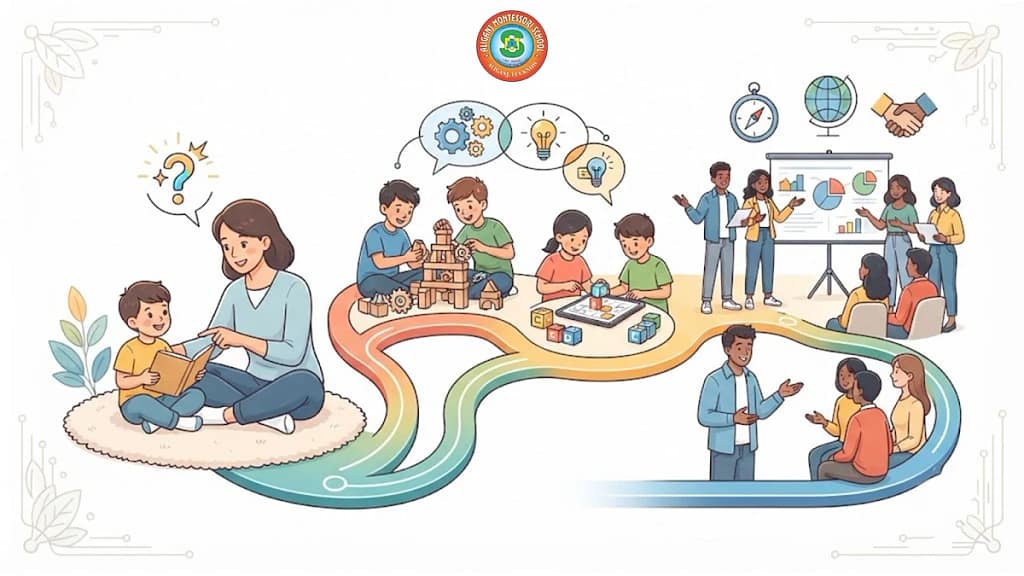

A Parent’s Guide to Nurturing Future-Ready Children with Aliganj Montessori School
The digital era has transformed the way children learn, communicate, and interact with the world. With information available at their fingertips, today’s children are growing up in an environment vastly different from previous generations. While technology has created countless opportunities for learning and innovation, it has also raised an important question for parents and educators:
How can we raise independent thinkers in a world where answers are only a click away?
Future success will not belong to children who simply memorize information. Instead, it will belong to those who can think critically, solve problems creatively, make informed decisions, and adapt confidently to changing circumstances. Independent thinking is becoming one of the most valuable future-ready skills in modern education.
At Aliganj Montessori School, we believe that education should empower children to become curious learners, confident decision-makers, and responsible individuals. As one of the trusted Montessori schools in Aliganj Lucknow, we focus on nurturing independent thinking through child-centered education, experiential learning, and holistic development.
This article explores how parents and schools can work together to raise independent thinkers in the digital age.
Table of Contents
Why Independent Thinking Matters More Than Ever
The future is becoming increasingly complex.
Children today will face:
- Rapid technological changes
- New career opportunities
- Artificial Intelligence integration
- Global competition
- Information overload
In such a world, simply knowing facts is not enough.
Children must learn how to:
- Analyze information
- Think critically
- Make decisions
- Solve problems
- Adapt to change
- Question assumptions
Independent thinkers become:
- Better learners
- More confident individuals
- Strong problem-solvers
- Future leaders
This is why modern schools are placing greater emphasis on critical thinking and future-ready education.
What Is Independent Thinking?
Independent thinking means the ability to:
- Form personal opinions
- Evaluate information objectively
- Make decisions confidently
- Think creatively
- Solve challenges without constant guidance
Independent thinkers do not simply accept information because someone tells them it is true.
Instead, they:
- Ask questions
- Explore different perspectives
- Analyze evidence
- Reach thoughtful conclusions
This mindset is essential in today’s digital world where children are exposed to vast amounts of information every day.
The Challenges of Raising Independent Thinkers Today
While technology provides incredible learning opportunities, it also presents challenges.
Children often:
- Receive instant answers online
- Depend heavily on digital devices
- Spend less time solving problems independently
- Face distractions from social media and entertainment
Without proper guidance, children may become information consumers rather than active thinkers.
Parents and schools must help children move beyond simply finding answers and instead focus on understanding, evaluating, and applying knowledge.
Encourage Curiosity from an Early Age
Curiosity is the foundation of independent thinking.
Children naturally ask questions such as:
- Why is the sky blue?
- How do plants grow?
- Why do people speak different languages?
Instead of immediately providing answers, encourage children to explore and discover.
Try asking:
- What do you think?
- How could we find out?
- Why do you believe that?
This approach develops:
- Critical thinking
- Problem-solving abilities
- Research skills
- Intellectual confidence
At Aliganj Montessori School, curiosity-driven learning is an essential part of the Montessori approach.
Let Children Make Age-Appropriate Decisions
Decision-making is a skill that develops through practice.
Allow children to make simple choices such as:
- Selecting books to read
- Choosing extracurricular activities
- Planning study schedules
- Organizing personal belongings
When children make decisions, they learn:
- Responsibility
- Consequences
- Confidence
- Independence
Montessori education encourages children to make choices within structured environments, helping them develop self-reliance naturally.
Teach Children How to Think, Not What to Think
One of the most important goals of education is teaching children how to think independently.
Instead of focusing only on correct answers, encourage:
- Open discussions
- Creative problem-solving
- Perspective-taking
- Analytical thinking
Ask questions like:
- What are different ways to solve this?
- Why do you think that happened?
- What would you do differently?
This develops flexible thinking and intellectual independence.
Encourage Reading Beyond Textbooks
Reading broadens perspectives and encourages independent thought.
Children should be exposed to:
- Storybooks
- Biographies
- Science books
- History books
- Educational magazines
Reading helps children:
- Explore new ideas
- Build imagination
- Improve comprehension
- Develop empathy
At Aliganj Montessori School, reading is encouraged not only for academic growth but also for creativity and lifelong learning.
Limit Overdependence on Technology
Technology is valuable, but balance is essential.
Children should use technology for:
- Educational research
- Creative projects
- Interactive learning
- Digital literacy development
However, they should also spend time:
- Reading physical books
- Engaging in outdoor play
- Solving puzzles
- Participating in hands-on activities
Balanced technology use helps children become thoughtful users rather than passive consumers.
Encourage Problem-Solving
Children develop independent thinking when they solve challenges themselves.
When a child faces a problem:
- Avoid solving it immediately
- Ask guiding questions
- Encourage brainstorming
- Support exploration
Examples:
- Resolving a disagreement with a friend
- Completing a difficult assignment
- Building a project
Problem-solving builds:
- Confidence
- Creativity
- Resilience
- Critical thinking
Experiential learning environments are especially effective for developing these skills.
Allow Healthy Mistakes
Many parents feel tempted to protect children from failure.
However, mistakes are valuable learning opportunities.
When children make mistakes, they learn:
- Responsibility
- Adaptability
- Resilience
- Self-reflection
Instead of criticizing mistakes, encourage questions like:
- What did you learn?
- What would you do differently next time?
At Aliganj Montessori School, mistakes are viewed as part of the learning process rather than something to fear.
Foster Emotional Intelligence
Independent thinking is closely connected to emotional intelligence.
Children who understand their emotions can:
- Make better decisions
- Handle challenges calmly
- Communicate effectively
- Build stronger relationships
Emotional intelligence supports:
- Leadership skills
- Confidence
- Social development
Future education increasingly recognizes emotional intelligence as a critical life skill.
Promote Creative Thinking
Creativity and independent thinking go hand in hand.
Encourage activities such as:
- Art
- Storytelling
- Music
- Building projects
- Creative writing
Creative activities teach children:
- Innovation
- Imagination
- Flexible thinking
Future careers will increasingly reward creativity and originality.
Encourage Meaningful Conversations
Family discussions help children develop independent viewpoints.
Talk about:
- Current events
- Science discoveries
- Community issues
- Books and stories
Ask open-ended questions and encourage respectful debate.
Meaningful conversations improve:
- Communication skills
- Analytical thinking
- Confidence in expressing opinions
The Role of Montessori Education in Independent Thinking
Montessori education is uniquely designed to nurture independent thinkers.
Key Montessori principles include:
- Child-centered learning
- Self-directed exploration
- Practical life activities
- Experiential education
- Freedom within structure
Children learn to:
- Take responsibility
- Make choices
- Solve problems
- Think independently
At Aliganj Montessori School, these principles help students become confident learners and future-ready individuals.
Why Experiential Learning Supports Independence
Experiential learning allows children to learn through:
- Hands-on activities
- Real-world experiences
- Interactive projects
- Exploration
This approach helps children:
- Understand concepts deeply
- Develop problem-solving skills
- Build confidence
Experiential learning prepares children for future challenges more effectively than rote memorization alone.
Building Future-Ready Learners
The future will reward individuals who can:
- Think critically
- Learn continuously
- Adapt quickly
- Solve complex problems
- Communicate effectively
Independent thinking forms the foundation of all these skills.
Future-ready education focuses on:
- Creativity
- Leadership
- Emotional intelligence
- Digital literacy
- Independent learning
At Aliganj Montessori School, students are encouraged to develop these qualities through holistic and child-centered education.
Why Parents and Schools Must Work Together: Montessori schools in Aliganj
Raising independent thinkers requires collaboration between parents and educators.
When schools and families work together:
- Learning becomes more consistent
- Children receive stronger support
- Confidence grows
- Independence develops naturally
The most successful learners often benefit from strong parent-school partnerships.
Conclusion: Independent Thinkers
In the digital era, information is everywhere, but independent thinking remains one of the most valuable skills a child can develop. Future success will depend not on how much information children memorize but on how effectively they can think, question, analyze, and innovate.
At Aliganj Montessori School, we believe that independent thinkers become confident learners, creative problem-solvers, and responsible future leaders. Through Montessori education, experiential learning, emotional development, and holistic growth, we help students build the skills they need to thrive in a rapidly changing world.
By encouraging curiosity, decision-making, creativity, and resilience, parents and schools can work together to raise children who are prepared not just for exams—but for life.
Frequently Asked Questions: Digital literacy development
What is independent thinking in children?
Independent thinking is the ability to analyze information, form opinions, make decisions, and solve problems confidently.
Why is independent thinking important in the digital age?
Children are exposed to vast amounts of information online. Independent thinking helps them evaluate information critically and make informed decisions.
How can parents encourage independent thinking?
Parents can encourage curiosity, allow decision-making, support problem-solving, and ask open-ended questions.
Does Montessori education promote independent thinking?
Yes. Montessori education emphasizes self-directed learning, decision-making, exploration, and responsibility.
How does experiential learning support independence?
Experiential learning helps children learn through real-world experiences, encouraging problem-solving and confidence.
What future skills are connected to independent thinking?
Independent thinking supports creativity, leadership, communication, adaptability, emotional intelligence, and critical thinking.
Looking for a school that nurtures independent thinkers, confident learners, and future-ready leaders?
Visit Aliganj Montessori School and discover how Montessori education empowers children to think creatively, learn independently, and succeed confidently in the digital age.
Admissions Open for 2026 – Give Your Child the Foundation for Lifelong Learning and Independent Thinking.