

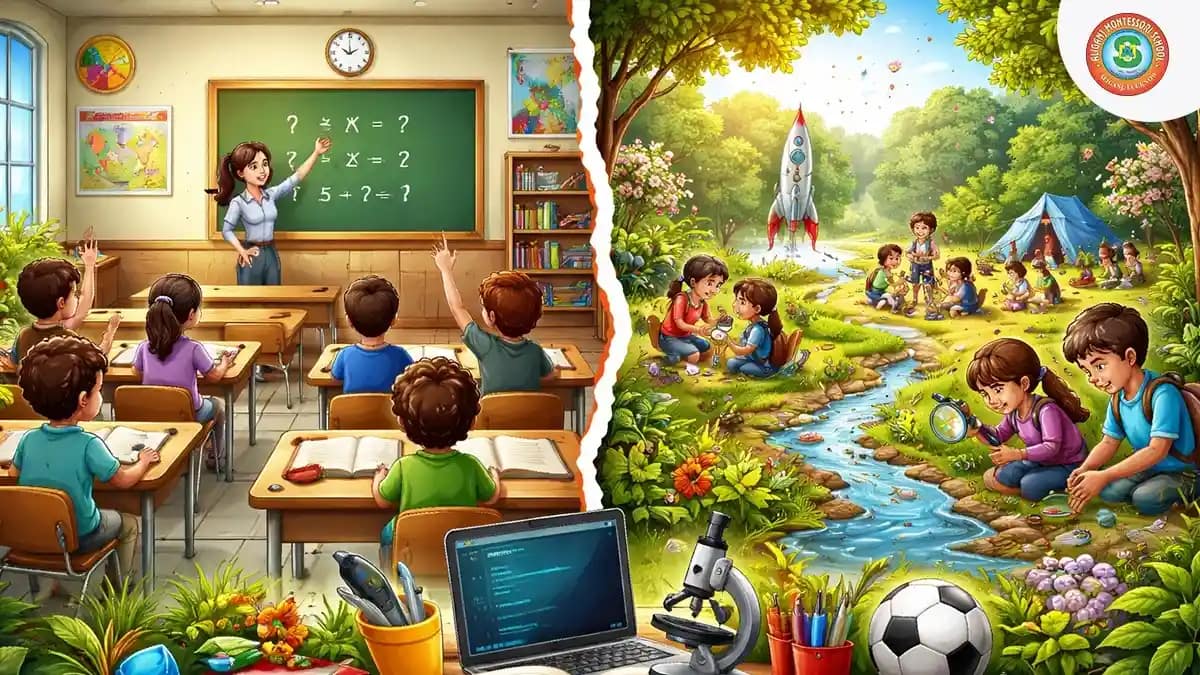


Montessori vs Traditional Pre-Primary Education: The days when education in early childhood entailed playing and memorizing the alphabet and numbers are a thing of the past. Modern parents, especially in Lucknow, have realized that a student’s success, personality, and confidence in their academic pursuits are shaped in their pre-primary years. This realization has, in fact, increased a comparison between Montessori and Pre-primary schooling.
As the parents look for the best Montessori schools in Lucknow, or the best pre-primary schools in Aliganj, or schools which train children for CBSE, their search naturally lands on the name Aliganj Montessori School.
The given write-up provides an in-depth analysis of Montessori vs traditional education in the pre-primary sector, along with reasons for the superiority of AMS in the city of Lucknow regarding laying strong foundations in children.
Table of Contents
Comprehending Pre-Primary Education
Pre-primary education is the first formal endeavor in the life of a child. It provides the foundation for the following:
- Cognitive development
- Language and communication skills
- Mental and Social Maturity
- Learning Discipline & Curiosity
However, not all pre-primary educational systems treat the preceding stage in the same manner. The distinction between Montessori education and traditional education is in the manner of learning and not in the learning content.
What Is Traditional Pre-Primary Education?
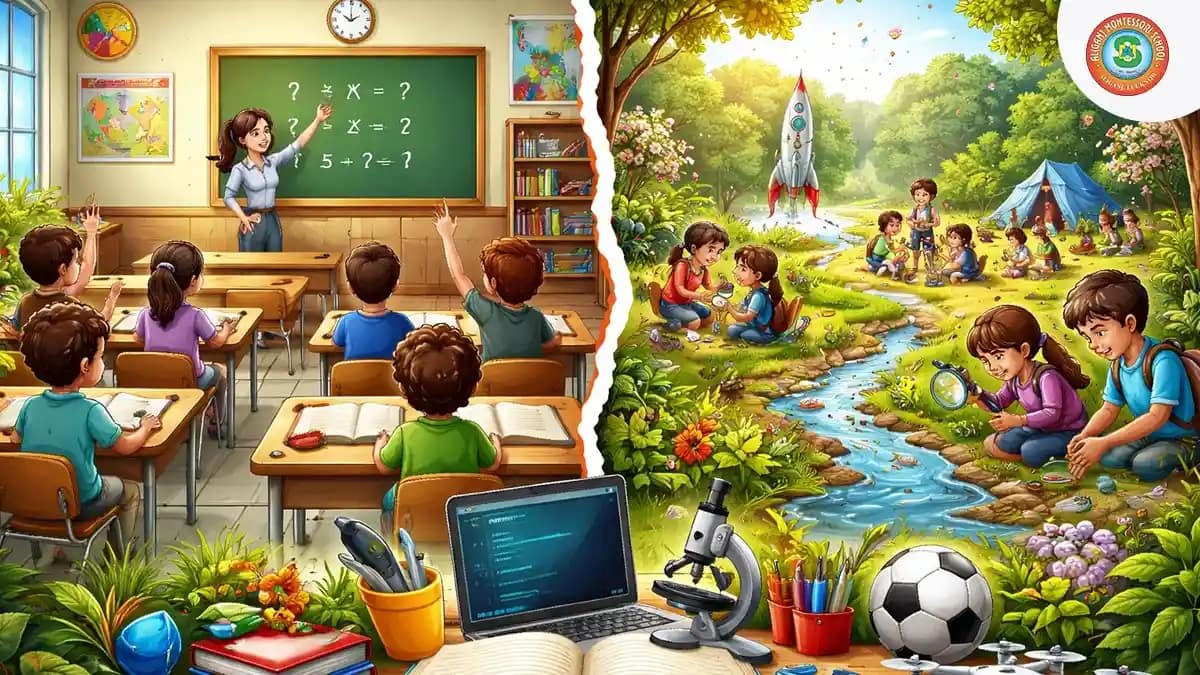
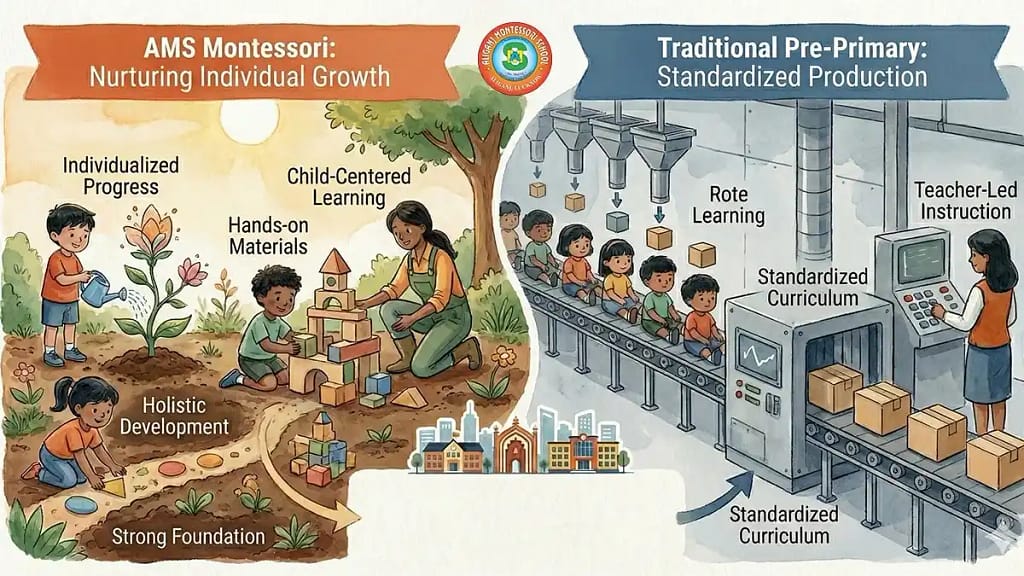
Traditional pre-primary education is teacher-centered, which is characterized by the following:
- The teacher leads the class.
- Children learn in groups, at the same rate
- Worksheets, repetition, and memorization can be the focal points
- Results/Outcomes
Even though this system exposes children to the classroom and the structure that must be followed there.
- Does not take into account individual learning speed
- Promotes Passive Learning
- Encourages early academic achievement
However, this is where Montessori education presents an attractive alternative.
Introduction to Montessori Education
Montessori education is an approach to learning developed by Maria Montessori, which focuses on the natural learning tendencies of children. Instead of teaching children by forced learning, the approach lets them investigate concepts by hands-on activities.
At AMS, the Montessori education includes:
- Independence
- Self-discussion
- Clarity in concept
- Learning by doing and discovery
In light of this, AMS has emerged as one among the finest Montessori schools within Aliganj Lucknow.
Montessori vs. Traditional Pre-Primary Education
1. Approach to Learning – Child Led vs Teacher Led
Teacher makes decisions on what, how, and when pupils acquire knowledge, Children passively receive instruction.
Montessori at AMS:
- Children participate in activities under a structured setting
- Teachers as guides, not instructors
This builds confidence in a child to own learning, which will help them for their entire CBSE schooling.
2. Learning Pace: Personal Learning Pace and Uniform Learning Pace
Traditional System:
- The same pace for all children
- Faster learners may lose interest. Others learn very slowly,
AMS Montessori System:
- Each child learns at their own rate.
- Most kids don’t get attention.
- “No comparison, no pressure.”
This is why AMS is preferred by parents when they look for a stress-free pre-primary school in Lucknow.
3. Concept Understanding vs. Memorization
- Concentration on memorizing or learning Alphabets, Numbers,
- Poor understanding of ‘why’ and ‘how’
Montessori at AMS:
- They learn about the properties of numbers
- Language is constructed by phonetics and communication
- Concepts are understood profoundly
Such conceptual clarity is a strong preparation for children for learning in a CBSE class.
4. Independence and Responsibility
Traditional Education:
- Children rely on teachers for instructions
- Limited decision-making autonomy
AMS Montessori Education:
- Children choose what they do
- Develop ability to do things alone
- Develop responsibility early
Parents will notice that AMS students emerge as confident, well-organized, and self-sufficient people.
5. Discipline: Forced Discipline vs Habits
- Discipline maintained by regulation and correction
- Children act in obedience to fear and/or pressure.
- Children know the meaning of responsibility instinctively
It makes the transition to CBSE class discipline in schools easier and healthier.
6. Language Development
Language readiness is important for CBSE schools.
Typical Approach:
- Early emphasis on writing alphabets
- Reduced focus on communication
AMS Montessori Method:
- Phonetic learning
- Storytelling and expression
- Learning new words through interaction
Consequently, the students from AMS possess excellent English understanding and speaking abilities before they enroll in primary school.
7. Numeracy and Mathematical Thinking
- Repeating to Count
- Early sheets without understanding
Montessori in AMS:
- Numbers learned using Montessori math materials
- Logic and the sequencing of numbers
It fosters problem-solving skills, which are an important ingredient in mathematics.
8. Emotional and Social Development
Traditional System:
- Emphasis on emotional learning over other areas
- Competition introduced early
- Giving priority to cooperation and empathy
- Children learn respect, sharing, patience
This emotional preparedness makes the children more receptive to group learning in the CBSE school.
Why AMS Leads Montessori Education in Lucknow
“The American Montessori Society does not merely make Montessori claims; it practices Montessori.”
Pivotal reasons why AMS dominates in Lucknow:
- Many years of working with the Montessori system
- Smooth Transition to CBSE Curriculum.
- ACU+ Better balanced in academics and soft skills
- Safe, structured, and child-friendly setting
For these reasons, it has always been one of the top pre-primary schools in Lucknow.
AMS Montessori + CBSE Advantage
We Unlike most Montessori schools that focus on early education alone, AMS provides the whole educational experience.
Children enjoy the following benefits:
- Montessori foundation in pre-primary
- Organized CBSE syllabi in higher classes
- Continuity in teaching philosophy
Thus, the absence of a learning gap makes AMS one of the most trusted CBSE Montessori Schools in Lucknow.
Reasons why Parents in Lucknow Prefer AMS Over Traditional Schools
Parents looking for:
- Montessori Comparative to Conventional Pre-School
- best pre-primary school in Lucknow
- Montessori Schools in Aliganj
Choose AMS because:
- Children enjoy learning
- Academic readiness increases
- Emotional development takes precedence
- Emotional development
- The transition for CBSE is smooth
Comparison Table: Montessori at AMS vs Traditional Pre-Primary
| Aspect | Montessori at AMS | Traditional Pre-Primary |
| Learning Style | Child-centric | Teacher-centric |
| Pace | Individual | Uniform |
| Focus | Concept clarity | Memorisation |
| Discipline | Habit-based | Rule-based |
| Emotional Growth | Strong focus | Limited |
| CBSE Readiness | High | Moderate |
FAQs—Montessori vs. Traditional Pre-Primary at AMS
1. How Is Montessori Education More Effective Than Traditional Pre-primary Education?
Yes, Montessori education tends to emphasize developing more independence, understanding, and well-rounded development, thus making it more effective in the early years.
2. What makes AMS the top Montessori school in Lucknow?
Since AMS adopts genuine Montessori techniques and a seamless CBSE pattern.
3. Montessori Children: Adaptable to CBSE Pattern?
Yes. It equips children both intellectually and mentally to study through the CBSE system.
4. What age group does AMS Montessori support?
Children from 2.5 to 6 years old. This includes Nursery, LKG, and UKG
5. Is writing and/or reading a focus of AMS at a relatively young age?
Yes, but in an age-appropriate and stress-free manner.
6. Is Montessori education appropriate for all children?
Absolutely. Montessori teaching accommodates varied learning modalities and rhythms.
7. In what ways does AMS promote holistic development?
Through the acquisition of knowledge, character, and self-reliance.
8. Why Choose AMS Over Traditional Pre-Primary Institutions?
Because AMS provides a more solid foundation for success in CBSE.
Conclusion: Montessori vs Traditional Pre-Primary Education
A comparison of Montessori education and traditional pre-primary education can be well understood when analyzing child development. Montessori education views the learning process in children, rather than the content of their learning.
In Aliganj Montessori School, the Montessori education is provided in a planned and visionary way, thus equipping the kids to enter the primary school with
- Embolden
- Independent
- Academically Prepared
- Emotionally Secure
Also, parents looking for the best Montessori school in Aliganj Lucknow will still find AMS a winning option. Admission to the next academic session is now open. Give your child the gift of a learning system that provides strong foundations and lifetime confidence.
Click on the link below to go to the official website of Aliganj Montessori School or you can contact the management of the school to admit your child to the Montessori education system