





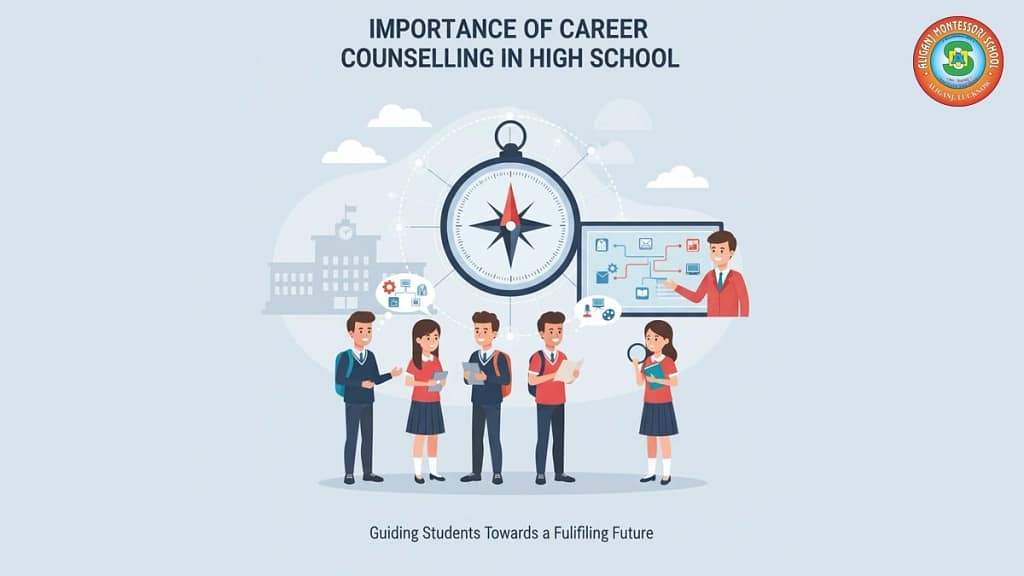

Importance of Career Counselling: In today’s highly competitive world, with career prospects changing by the day and new vocations emerging annually, students find themselves perplexed on what to do after school. Most high school students make academic or career decisions without any guidance — resulting in unhappiness, tension, and unexplored potential later in life. Career counselling in school steps in to prevent this.
Career guidance is not merely selecting a profession — it’s identifying your strengths, interests, personality, and values, and matching them with a viable career option.
High school is the most critical period for decision-making, and appropriate career guidance and counselling at the right time can guide students toward making informed decisions that lay the pillars of their personal and professional achievement.
Table of Contents
What is Career Counselling in High School?
High school career guidance is a systematic guidance process in which students are made to search for different academic and career options by trained counsellors.
It includes:
- Evaluation of strengths and interests by means of aptitude and personality assessments.
- Search for career alternatives in different professions.
- Establishing educational and career objectives commensurate with a student’s ambitions.
- Creating awareness regarding skill acquisition, college courses, and future prospects.
In short, career counselling assist pupils to transit from confusion to clarity and from uncertainty to confidence.
Why Career Counselling is Necessary in High School
Assist Pupils to Find Out Their True Potential
Most students do not know their strength or area of interest. Career counselling employs scientific methods such as aptitude tests, psychometric analysis, and personality mapping to assist pupils in finding their true potential.
Avoids Wrong Career Choices
Guidance helps students make decisions independently of peer pressure and parent expectations. Career guidance ensures students make decisions based on their abilities and personality — not fashion.
Connects Education to Career Objectives
Career guidance assists students in choosing subjects and courses that are aligned with their career goals. This makes it easier for them to avoid confusion regarding “What stream do I take after Class 10?” or “What degree suits my career plans?”
Develops Confidence and Motivation
With clarity of direction, students develop greater motivation and confidence in themselves. Career clarity also eliminates anxiety and stress related to studies.
Promotes Well-Informed Decision-Making
Career guidance offers proper information regarding various career paths — from conventional careers in medicine and engineering to new ones such as AI, digital marketing, and robotics.
Aids Students in Preparation for the Future Workforce
When there is rapid change in technology and industries in an evolving world, career guidance empowers students with the aptitude and intellect to fit in and excel.
Encourages Parental Comprehension
Career counselling assists parents in comprehending current career options and minimizes conflict between student and parental aspirations.
The Major Advantages of Career Counselling in High School
Academic Clarity
Students are taught about how their high school subject choices impact their future college and careers.
Goal Setting and Planning
Early goal setting is promoted by career counselling to enable students to formulate step-by-step plans towards long-term success.
Awareness of Opportunities
The students become enlightened regarding lesser-known but rewarding job opportunities in areas such as design, data science, sports management, hospitality, biotechnology, AI, and renewable energy.
Time and Resource Efficiency
By not making mistakes or conducting experiments later on, students save energy, money, and time.
Personal Growth
Career guidance develops vital life skills like communication, decision-making, self-awareness, and resilience.
Emotional Well-being and Stability
When students are guided and given clarity, it avoids confusion, peer pressure, and stress — making the learning experience mentally sound.
The Career Counsellor: The Guide in a Student’s Life
A career counsellor is a mentor, psychologist, and advisor all in one — assisting students in making the right choices at each stage.
The role of the counsellor includes:
- Performing aptitude and psychometric tests.
- Clarifying career choices on the basis of test scores.
- Guiding students in subject selection, college choices, and courses.
- Advising them regarding scholarships, internships, and entrance exams.
- Emotional well-being support during decision-making.
Career counsellors do not offer generic advice but instead personalized advice so that each student’s journey is honored.
High School Career Counselling Process
An organized career counselling process involves:
- Self-Assessment: Assessment of interests, skills, strengths, and values through psychometric assessments.
- Exploration: Investigation of multiple career pathways and awareness of future prospects.
- Guidance Sessions: Personalised one-on-one counselling sessions with a certified professional.
- Career Mapping: Developing a personalized roadmap to education and career.
- Skill Development: Determining essential competencies to be developed for selected careers.
- Action Plan: Establishing realistic short-term and long-term objectives.
This scientific process converts career confusion to clarity and confidence.
Significance of Career Counselling in Contemporary Education
Supporting Students to Emerging Careers
Future-proof jobs such as data analytics, AI engineering, UX design, renewable energy, and e-commerce demand future-ready skills. Career guidance ensures students know about future job markets.
Blending Soft Skills with Academics
Today, success in careers is not just about technical expertise but also about soft skills such as team-working, creativity, and communication. Counselling initiatives assist in developing such skills early.
Dropout Rate Reduction
Students who are unclear about their stream or college course are more likely to drop out. Career guidance makes them take the correct path, reducing academic dropouts.
Increasing Employability
Career guidance directs students to courses and skills enhancing employability. It equips them with what is required in the future workplace.
Rendering Students Future-Ready
With automation looming, students must adapt, upskill, and learn throughout their lives. Career guidance fosters lifelong learning and adaptability.
School Role in Encouraging Career Counselling
Schools have to consider career counselling as a fundamental component of education, rather than a peripheral add-on.
Schools can do:
- Hold career guidance workshops and career counselling days.
- Provide individual career sessions for students and parents.
- Collaborate with career counselling professional organizations.
- Integrate career readiness programs in the curriculum.
- Organize skill development and internship programs for exposure.
When schools make career counselling a priority, they see that all students graduate with a sense of purpose and direction.
Myths about Career Counselling
| Myth | Reality |
| Career counselling is only for weak students. | It’s for all students — to identify strengths and find the right fit. |
| Career counselling means choosing one fixed career for life. | It helps explore flexible career paths and future opportunities. |
| Only parents should decide a child’s career. | The student’s interests, aptitude, and goals must drive decisions. |
| Counselling is only needed after high school. | Early counselling in high school builds stronger career foundations. |
Career Counselling Tools and Techniques
Scientific, evidence-based tools are employed in modern career counselling to accurately appraise:
- Aptitude Tests – To measure logical, numerical, and verbal reasoning.
- Interest Inventories – To determine passion and motivation domains.
- Personality Assessments – To establish work styles and preferences.
- Career Mapping Software – For matching profiles to appropriate careers.
These applications enable counsellors to give accurate and actionable career guidance.
Long-Term Career Counselling Benefits in High School
- Produces goal-set students with greater motivation.
- Decreases academic anxiety and confusion.
- Increases confidence and self-knowledge.
- Improve student performance and concentration.
- Develops a future-proof mindset.
- Enhances school reputation with successful graduates.
Career Counselling FAQs for High School
1. At what age is it appropriate to seek career counselling?
The best time is while in high school (Grades 9–12). Early advice enables one to pick the correct stream and develop appropriate skills.
2. Why is career counselling necessary for students?
It assists students to know their interests, strengths, and abilities, leading them to rewarding and appropriate careers.
3. How does career counselling assist high school students?
It brings clarity, direction, and confidence in selecting subjects, streams, and college courses in line with career aspirations.
4. What does a career counselling session entail?
Students are evaluated, learn about career possibilities, review results with the counsellors, and create individual action plans.
5. Is career counselling for only confused students?
No, it’s worth it for all students — even those who have answers — to confirm choices and pursue new possibilities.
6. Can students use career counselling to select the best college?
Yes. Counsellors advise students on college choice, entrance exams, scholarships, and study abroad opportunities.
7. How does career counselling assist parents?
It enables parents to grasp contemporary career trends and match their expectations with the interests and capabilities of their child.
Conclusion
High school career counselling is not a nicety — it’s a necessity. It connects school and work, converting doubt into opportunity. When young people are clear about their strengths, values, and passions early in life, they’re more likely to select careers that lead to success, satisfaction, and meaning.
In today’s rapidly evolving world, career guidance makes students relevant, goal-oriented, and assured about their future. It brings education from learning to planning for life.
We at AMS feel that each student should have a clear, sure, and mission-based future. Our Career Guidance and Counselling Programs make students make informed decisions, discover international opportunities, and construct careers that match their aspirations.
Join AMS today — where career clarity meets academic excellence.
Explore AMS Career Counselling Programs | Contact AMS Team