
Montessori Schools vs Traditional Schools: Which Is Right for Your Child?
One of the biggest decisions parents make before their child’s admission is choosing the right educational approach. With increasing awareness about modern teaching methods, many families are asking an important question:
Should we choose a traditional school or a Montessori school?
Both educational systems aim to help children learn and grow, but they differ significantly in teaching methods, classroom environment, learning style, and child development philosophy.
Today’s parents are no longer looking only for good academic results. They want schools that help children become confident, creative, emotionally strong, and ready for the future. This has made Montessori education increasingly popular, especially during the early years of learning.
At Aliganj Montessori School (AMS), we believe that every child learns differently. By combining the globally respected Montessori philosophy with the CBSE curriculum, AMS offers a balanced educational experience that develops both academic excellence and lifelong skills.
This guide will help parents understand the differences between traditional schools and Montessori schools so they can make an informed decision for their child’s future.
Table of Contents
Quick Answer: What Is the Difference Between Montessori Schools and Traditional Schools?
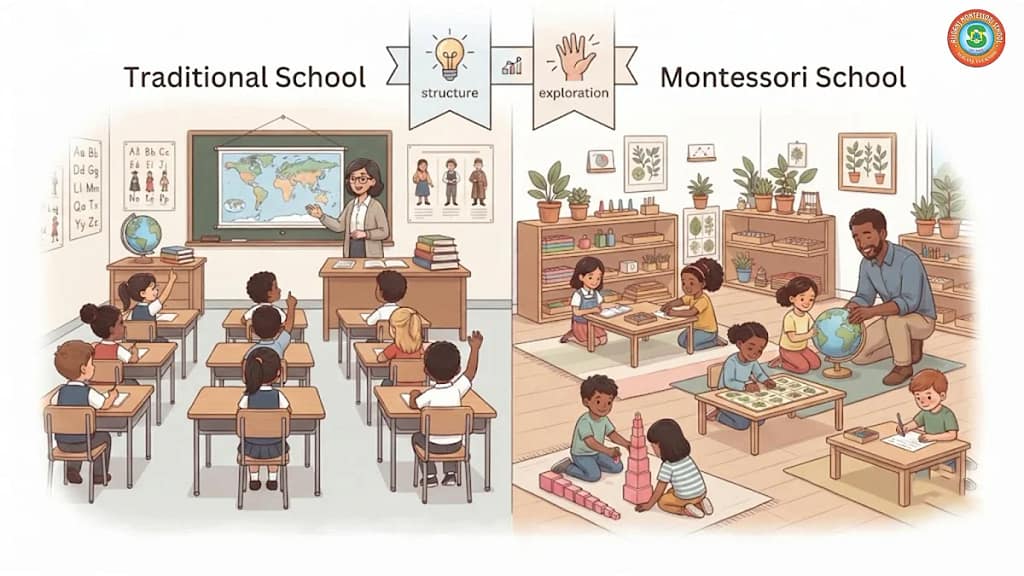
Montessori schools focus on child-centered, activity-based, and self-paced learning, encouraging independence, creativity, and practical life skills. Traditional schools generally follow teacher-led instruction, structured classrooms, fixed lesson plans, and standardized teaching methods. Montessori education emphasizes exploration and holistic development, while traditional education often follows a more uniform academic structure.
Why More Parents Are Comparing Montessori and Traditional Schools
Education has changed significantly over the past decade.
Earlier, parents mostly evaluated schools based on:
- Academic reputation
- Examination results
- Discipline
- Infrastructure
Today, parents also consider:
- Learning environment
- Emotional development
- Creativity
- Individual attention
- Future-ready skills
- Child happiness
- Holistic development
As a result, many families searching for the Best Montessori School in Lucknow or the Best CBSE School in Lucknow want to understand which educational approach best supports their child’s growth.
What Is Traditional School Education?
Traditional education is the teaching model that has been followed in schools for many years.
Typically, traditional classrooms include:
- Teacher-led instruction
- Fixed curriculum
- Same lessons for all students
- Age-wise classroom grouping
- Structured timetable
- Standardized assessments
The teacher explains concepts while students listen, take notes, complete assignments, and prepare for examinations.
Traditional schools provide a structured learning environment that helps students develop discipline, routine, and academic consistency.
Many successful individuals have been educated through traditional systems, and this approach continues to be effective when combined with modern teaching practices.
Characteristics of Traditional Classrooms
Traditional classrooms generally focus on:
- Completing the syllabus
- Classroom lectures
- Textbook learning
- Written assignments
- Regular examinations
- Teacher guidance
Students usually progress together according to the academic calendar.
The classroom follows a common pace for all learners.
While this structure works well for many students, younger children sometimes benefit from more flexible and exploratory learning experiences.
What Is Montessori Education?
Montessori education is a globally recognized child-centered educational approach developed by Dr. Maria Montessori.
It is based on a simple belief:
Children learn best when they are actively involved in their own learning.
Instead of simply receiving information, children are encouraged to:
- Explore
- Observe
- Experiment
- Discover
- Practice independently
- Learn through meaningful activities
The Montessori classroom is carefully prepared to allow children to develop confidence, curiosity, responsibility, and independence naturally.
At Aliganj Montessori School, Montessori principles help young learners enjoy education while building a strong academic and personal foundation.
Montessori Education Encourages Natural Learning
Every child has a unique learning style.
Some children learn best by:
- Seeing
- Touching
- Listening
- Practicing
- Exploring
Montessori education respects these differences.
Rather than expecting every child to learn in exactly the same way, teachers guide children according to their developmental stage and learning pace.
This personalized approach creates confident learners who enjoy discovering new concepts.
Teacher-Centered vs Child-Centered Learning
One of the biggest differences between the two systems is the role of the teacher.
Traditional Education
The teacher is usually the primary source of knowledge.
Students:
- Listen
- Observe
- Follow instructions
- Complete assignments
Learning is generally directed by the teacher.
Montessori Education
The teacher acts as:
- Guide
- Facilitator
- Mentor
- Observer
Children actively participate in learning through carefully designed activities and experiences.
Teachers encourage curiosity rather than simply providing answers.
This helps children develop independent thinking.
Structured Learning vs Exploratory Learning
Traditional education often follows a fixed lesson sequence.
Every student studies:
- The same lesson
- At the same time
- Using similar teaching methods
Montessori classrooms offer greater flexibility.
Children are encouraged to:
- Explore concepts
- Repeat activities
- Learn at their own pace
- Develop concentration
- Build practical understanding
This does not mean Montessori lacks structure.
Instead, the structure is designed around children’s developmental needs rather than rigid classroom routines.
Which Approach Is Better for Early Childhood?
The early years of education are critical for brain development.
Children between the ages of 3 and 6 years naturally learn through:
- Curiosity
- Observation
- Play
- Practical experiences
- Exploration
This is why Montessori education has become one of the most respected approaches for Early Childhood Education.
By encouraging children to explore independently, Montessori classrooms help build:
- Confidence
- Communication
- Concentration
- Coordination
- Creativity
- Responsibility
These qualities provide a strong foundation before children move into more structured academic learning.
Why Activity-Based Learning Matters
Children remember experiences much longer than memorized information.
Activity-based learning helps students:
- Understand concepts
- Improve concentration
- Develop fine motor skills
- Build logical thinking
- Strengthen communication
- Enjoy learning
At Aliganj Montessori School, learning happens through carefully planned activities that encourage children to think, observe, and discover.
This approach transforms education into an enjoyable experience rather than a routine task.
Why AMS Combines Montessori Philosophy with CBSE Excellence
At Aliganj Montessori School, we recognize that children benefit from both child-centered learning and strong academic foundations.
That is why our educational approach combines:
- Montessori Philosophy
- CBSE Curriculum
- Activity-Based Learning
- Child-Centered Classrooms
- Holistic Development
- Experiential Learning
- Individual Attention
- Future-Ready Education
This balanced model helps students enjoy learning during their foundational years while preparing them for long-term academic success.
Comparing Learning Experiences in Traditional and Montessori Classrooms
Choosing the right educational approach is not about deciding which system is universally better—it is about understanding which environment best supports your child’s learning style, personality, and future development.
Both Traditional School Education and Montessori Education have their own strengths. However, modern parents are increasingly looking for schools that develop not only academic excellence but also creativity, confidence, communication skills, and emotional intelligence.
Let’s compare the two approaches across the areas that matter most to parents.
Classroom Environment: Structured vs Flexible Learning
One of the first differences parents notice is the classroom atmosphere.
Traditional Classrooms
Traditional classrooms generally follow:
- Fixed seating arrangements
- Teacher-led instruction
- Common lesson plans
- Uniform classroom activities
- Scheduled subject periods
Students usually complete the same activity at the same time under teacher supervision.
This structure helps establish routine and discipline.
Montessori Classrooms
Montessori classrooms are designed as learning environments where children actively explore concepts.
Students have opportunities to:
- Choose learning activities
- Work independently
- Collaborate with classmates
- Learn through specially designed educational materials
- Move comfortably between learning stations
The classroom encourages curiosity, responsibility, and independent decision-making while maintaining a well-organized learning environment.
At Aliganj Montessori School, Montessori-inspired classrooms create opportunities for children to become active learners rather than passive listeners.
Teacher’s Role: Instructor vs Learning Guide
The teacher plays an important role in both educational systems.
The difference lies in how learning is facilitated.
Traditional Schools
Teachers generally:
- Deliver lessons
- Explain concepts
- Assign classwork
- Evaluate progress
- Lead classroom discussions
Students depend mainly on teacher instruction for learning.
Montessori Schools
Teachers carefully observe each child’s:
- Learning pace
- Interests
- Strengths
- Developmental needs
Instead of giving every answer immediately, teachers guide children toward discovering solutions independently.
This encourages:
- Critical thinking
- Problem-solving
- Confidence
- Responsibility
At Aliganj Montessori School, teachers act as mentors who encourage exploration while providing continuous support throughout the learning journey.
Learning Style: Memorization vs Understanding
Perhaps the biggest difference lies in how concepts are learned.
Traditional Education
Learning often emphasizes:
- Textbooks
- Written exercises
- Homework
- Classroom lectures
- Examination preparation
Students learn concepts according to a fixed curriculum and assessment schedule.
Montessori Education
Children understand concepts through:
- Practical activities
- Observation
- Exploration
- Sensory experiences
- Collaborative learning
- Real-life applications
Instead of simply remembering information, children develop conceptual understanding that remains with them longer.
This makes learning both meaningful and enjoyable.
Assessments: Scores vs Continuous Development
Parents naturally want to understand how progress is measured.
Traditional Schools
Assessment commonly includes:
- Unit tests
- Homework evaluation
- Periodic examinations
- Report cards
- Academic grades
These assessments help monitor academic performance.
Montessori Schools
Progress is evaluated through continuous observation.
Teachers assess:
- Participation
- Confidence
- Communication
- Practical skills
- Concept understanding
- Social interaction
- Emotional growth
Academic learning remains important, but equal attention is given to overall development.
At Aliganj Montessori School, assessment focuses on helping every child improve while building confidence and a love for learning.
Independence vs Teacher Dependence
Modern education aims to develop children who can think independently.
Traditional Learning
Students usually receive direct instructions before completing tasks.
The teacher remains the primary source of classroom direction.
Montessori Learning
Children gradually learn to:
- Organize their work
- Make decisions
- Solve simple problems
- Complete activities independently
- Take responsibility for learning
These habits strengthen self-confidence and prepare children for lifelong learning.
Creativity and Innovation
The future workplace values creativity as much as academic knowledge.
Schools therefore need to encourage children to:
- Imagine
- Create
- Design
- Innovate
- Express ideas
Traditional Schools
Creative opportunities are usually provided through:
- Art classes
- Cultural activities
- Projects
- Competitions
Montessori Schools
Creativity becomes part of everyday learning.
Children express themselves through:
- Storytelling
- Practical activities
- Open-ended exploration
- Creative projects
- Collaborative problem-solving
This continuous exposure helps children develop innovative thinking from an early age.
Building Future-Ready Skills
Children entering school today will eventually work in careers that continue to evolve.
Future-ready learners need skills such as:
- Critical thinking
- Collaboration
- Communication
- Creativity
- Leadership
- Emotional intelligence
- Adaptability
Montessori education naturally develops many of these competencies because children learn through exploration, independence, and practical experiences.
At Aliganj Montessori School, these future-ready skills are developed alongside the structured academic framework of the CBSE curriculum.
Holistic Development Beyond Academics
Parents today increasingly value schools that focus on the complete development of their children.
Holistic development includes:
Academic Excellence
Strong conceptual understanding.
Emotional Growth
Confidence, empathy, and resilience.
Social Development
Communication, teamwork, and cooperation.
Physical Development
Sports, movement, and healthy habits.
Creative Development
Art, music, storytelling, innovation, and imagination.
Montessori classrooms support all these dimensions simultaneously, helping children become balanced individuals.
Why Many Parents Choose Montessori During Early Childhood
The early years are when children develop their strongest learning habits.
Montessori education provides opportunities to:
- Explore independently
- Build concentration
- Strengthen communication
- Develop practical life skills
- Improve coordination
- Build self-confidence
These experiences create a smooth transition into formal academics while preserving children’s natural curiosity.
How Aliganj Montessori School Creates the Best of Both Worlds
At Aliganj Montessori School, education combines the strengths of Montessori philosophy with the academic excellence of the CBSE curriculum.
Students benefit from:
- Montessori-Inspired Learning
- CBSE Academic Framework
- Child-Centered Classrooms
- Activity-Based Learning
- Experiential Education
- Individual Attention
- Holistic Child Development
- Future-Ready Skills
- Positive Learning Environment
- Experienced Educators
This balanced approach ensures children enjoy learning during their foundational years while building the knowledge, confidence, and skills needed for future academic success.
How to Choose the Best Learning Approach for Your Child
Choosing a school is one of the most important decisions parents make. While comparisons between Traditional Schools and Montessori Schools are common, the right choice ultimately depends on your child’s personality, learning style, developmental needs, and long-term goals.
Today’s world requires children to do much more than score well in examinations. They need to think independently, solve problems creatively, communicate effectively, and adapt to constant change. This is why many parents now prefer schools that combine strong academics with holistic child development.
At Aliganj Montessori School (AMS), we believe education should prepare children not only for school but also for life. By integrating Montessori philosophy with the CBSE curriculum, AMS offers students the best of both educational approaches.
Which Educational Approach Is Right for Your Child?
Every child is unique.
Some children learn quickly through observation.
Others learn best through:
- Practical activities
- Visual experiences
- Group interaction
- Independent exploration
- Hands-on learning
Instead of asking,
“Which education system is better?”
Parents should ask,
“Which learning environment will help my child become confident, curious, and successful?”
The answer often lies in choosing a school that understands children as individuals rather than expecting every student to learn in exactly the same way.
A Parent’s Checklist Before Choosing a School
Before making your admission decision, evaluate the school carefully.
Does the school focus on the child instead of only the syllabus?
The best schools adapt teaching methods according to children’s developmental needs.
Does the school encourage curiosity?
Children should feel comfortable asking questions, exploring ideas, and learning through discovery.
Is learning activity-based?
Hands-on experiences improve understanding far more effectively than memorization alone.
Does the school develop life skills?
Future-ready schools help children build:
- Communication
- Leadership
- Creativity
- Critical thinking
- Collaboration
- Emotional intelligence
Are teachers mentors?
Great teachers inspire children to think independently while providing guidance and encouragement.
Does the school support holistic development?
A balanced school develops:
- Academics
- Creativity
- Physical fitness
- Emotional wellbeing
- Social confidence
- Character
Is there strong parent-school communication?
Parents and teachers should work together to support every child’s educational journey.
Why Early Childhood Education Matters
The foundation of lifelong learning is built during the first few years of school.
Children develop:
- Confidence
- Curiosity
- Communication skills
- Learning habits
- Emotional resilience
- Independence
A positive learning experience during nursery and primary education often influences how children approach education for many years.
This is why choosing the right educational philosophy during the foundational years is so important.
Montessori Education Builds Lifelong Learners
One of the greatest strengths of Montessori education is that it encourages children to enjoy learning rather than study only for examinations.
Students gradually become:
- Independent learners
- Creative thinkers
- Responsible individuals
- Curious explorers
- Confident communicators
Instead of depending entirely on teachers, children learn how to observe, investigate, and solve problems independently.
These habits remain valuable throughout higher education and future careers.
Why Academic Excellence Still Matters
Modern education should balance innovation with academic discipline.
Children need:
- Strong literacy skills
- Mathematical understanding
- Scientific thinking
- Language development
- General knowledge
The CBSE curriculum provides this academic structure while preparing students for future competitive opportunities.
At Aliganj Montessori School, Montessori learning during the early years blends seamlessly with CBSE academic standards, allowing children to enjoy learning while developing a strong educational foundation.
The Perfect Balance: Montessori Philosophy + CBSE Excellence
Many parents believe they must choose between Montessori education and structured academics.
At Aliganj Montessori School, they don’t have to.
AMS combines:
Montessori Philosophy
- Child-centered learning
- Independent exploration
- Practical life activities
- Hands-on experiences
- Self-confidence
CBSE Excellence
- Strong academic curriculum
- Concept-based learning
- Structured progression
- Subject expertise
- Future academic readiness
This balanced approach helps children become both academically successful and personally confident.
Why Parents Choose Aliganj Montessori School
Families looking for the Best Montessori School in Lucknow, Best CBSE School in Lucknow, or a Child-Centered School in Aliganj trust AMS because of its commitment to complete child development.
Parents appreciate the school’s focus on:
- Montessori-inspired education
- CBSE curriculum
- Child-centered classrooms
- Activity-based learning
- Experiential education
- Holistic development
- Safe and nurturing environment
- Experienced educators
- Individual attention
- Future-ready learning
This combination ensures that students receive an education that supports both academic achievement and lifelong personal growth.
Why Future Education Requires More Than Good Marks
The careers of tomorrow will demand qualities that cannot be measured only through examinations.
Children will need to become:
- Innovative thinkers
- Effective communicators
- Team players
- Responsible leaders
- Lifelong learners
- Emotionally intelligent individuals
Schools that nurture these abilities prepare students for success in higher education, professional careers, and everyday life.
At Aliganj Montessori School, future-readiness begins from the earliest years through meaningful learning experiences, practical activities, and personalized guidance.
The AMS Difference
At Aliganj Montessori School, education goes beyond textbooks.
Students benefit from:
- Montessori-Based Learning
- CBSE Academic Excellence
- Child-Centered Education
- Activity-Based Classrooms
- Experiential Learning
- Future-Ready Skills
- Holistic Child Development
- Positive Teacher-Student Relationships
- Safe & Nurturing Campus
- Strong Parent-School Partnership
Every child is encouraged to grow academically, emotionally, socially, and creatively in an environment designed to inspire confidence and curiosity.
Conclusion: Montessori Schools vs Traditional Schools
Choosing between a Traditional School and a Montessori School is not about deciding which system is universally better—it is about selecting the educational approach that best supports your child’s individual growth and future aspirations.
Traditional education provides structure, consistency, and strong academic foundations, while Montessori education encourages independence, creativity, experiential learning, and holistic development. The most effective learning environment often combines the strengths of both approaches.
At Aliganj Montessori School, children benefit from a unique blend of Montessori philosophy and the CBSE curriculum, ensuring they receive both academic excellence and life skills. Through child-centered classrooms, activity-based learning, experienced educators, and a nurturing environment, AMS prepares students to become confident learners, compassionate individuals, and future-ready citizens.
The right school is one that inspires children to enjoy learning today while preparing them to succeed tomorrow.
Frequently Asked Questions: Montessori Schools vs Traditional Schools
1. What is the main difference between Montessori and traditional schools?
Montessori schools focus on child-centered, activity-based, and self-paced learning, while traditional schools generally follow teacher-led instruction, structured lesson plans, and standardized teaching methods.
2. Which is better for young children: Montessori or traditional education?
Montessori education is widely recommended during the early years because it encourages independence, creativity, practical learning, and holistic development while respecting each child’s natural learning pace.
3. Do Montessori students perform well academically?
Yes. Montessori students develop strong conceptual understanding, problem-solving abilities, communication skills, and independent learning habits that support long-term academic success.
4. Can Montessori education prepare children for the CBSE curriculum?
Yes. When implemented effectively, Montessori education builds strong foundational skills that help children transition smoothly into structured academic programs such as the CBSE curriculum.
5. Why do parents choose Aliganj Montessori School?
Parents choose AMS because it combines Montessori-inspired learning with CBSE academic excellence, offering child-centered education, holistic development, activity-based learning, experienced educators, and a future-ready approach.
6. How can parents decide which school is right for their child?
Parents should evaluate the school’s teaching philosophy, learning environment, teacher quality, child-centered approach, safety, holistic development programs, and parent-school communication before making an admission decision.
Give Your Child the Best of Montessori Learning and CBSE Excellence
Every child deserves an education that nurtures curiosity, builds confidence, and prepares them for a successful future. At Aliganj Montessori School, we combine the strengths of Montessori education with the CBSE curriculum to create a balanced learning experience that supports academic excellence, independent thinking, creativity, and holistic development.
If you’re searching for a trusted Montessori and CBSE school in Lucknow where your child can learn, grow, and thrive, we invite you to explore what AMS has to offer.
Admissions are now open. Help your child begin a lifelong journey of joyful learning and future-ready education.
Contact Us: https://amslucknow.in/contact-us/