
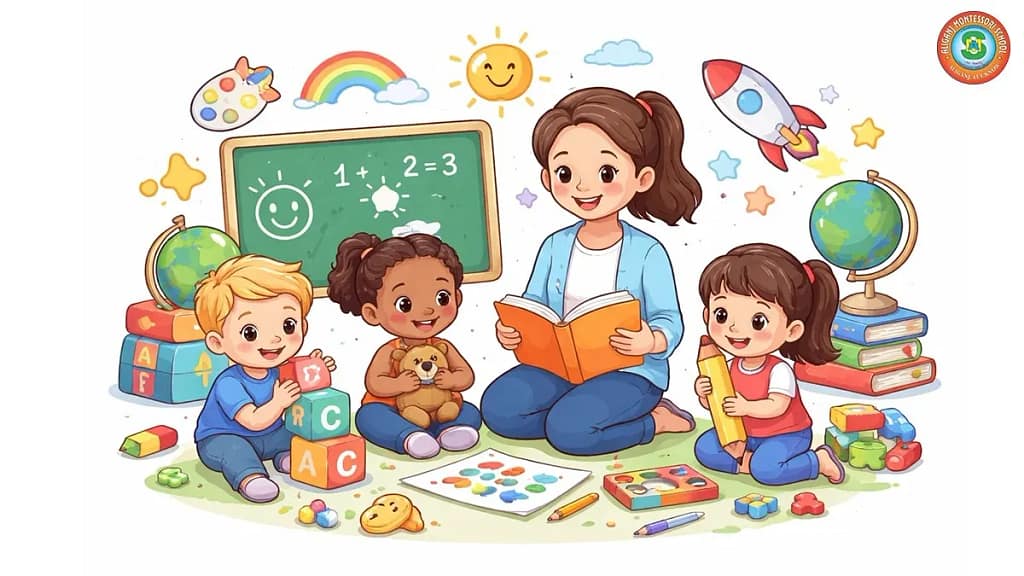

Benefits of Nursery Education: The first few years of a child‘s life are widely accepted to be the most important stage in their development. It is in these formative years that their intelligence, emotional development, and social skills are established. Nursery education has a significant impact on the development of these basic skills as they move from home to formal education.
A lot of parents wonder if nursery schooling is required at all. But the educators in this field agree that nursery schooling is highly influential in later stages of a child’s life. It allows children to get accustomed to the habit of learning. Nursery schooling is not only about fun. Children learn quite a few things that they can apply in their personal as well as academic lives.
Nursery education at Aliganj Montessori School is aimed at developing children‘s natural curiosity, creativity, and independence. As one of the best Montessori schools and CBSE schools in Lucknow, AMS seeks to deliver a safe, happy, and stimulating learning environment for your children.
Table of Contents
Understanding Nursery Education
Nursery education is the initial phase of formal education in which the children are engaged. It usually comprises children aged 2 and 4 years. It aims at enhancing the vital skills, mainly through play-based and activity-based methods of learning.
It is not the case for nursery education as compared to classroom education; it does not give that importance to the academic curriculum. Instead, it develops in children:
- Communication skills
- Emotional intelligence
- Motor skills
- Questions! Imagination and Inquisitiveness
The nursery classrooms at Aliganj Montessori School use a combination of Montessori-based learning techniques and contemporary methods of education to provide a fun and well-rounded learning experience.
Why Early Schooling Matters
Early years education is crucial, as in the early years the brain develops significantly. Early studies proved that almost 90% of development of the human brain takes place before a child is five years old.
It therefore suggests that the kinds of experiences that children are given to experience in the first few years are likely to be critical in determining their capacity to learn and adapt subsequently.
Nursery education helps children:
- Establish basic learning skills
- Increase confidence and independence.
- Get ready for primary school
By investing in early education, parents can equip their children with the best possible start in life.
Key Benefits of Nursery Education
1. Development of Social Skills
Social interaction is one of the greatest advantages of nursery education.
Children learn to
- Share with friends
- Work in groups
- Communicate with classmates.
Understand the concept of cooperation and teamwork
Aliganj Montessori School has working, individual, and group occupations, so the children are very comfortable in group situations and can interact freely in an open-ended, child-centered environment.
2. Improved Communication and Language Skills
Language is also a central theme in early childhood.
Nursery education helps children improve:
- Vocabulary
- Listening skills
- Verbal expression
- A clear understanding of the required task.
Teachers at AMS aim to promote through story times, songs, and ask-and-answer sessions.
3. Building Confidence and Independence
Nursery school children are given the opportunity to become independent in the simplest of activities, such as tidying their belongings, completing activities, and communicating with teachers and fellow pupils.
And this independence leads to self-confidence and self-esteem; it is also what a person needs for the success that his/her future studies might require.
The approach used here at Aliganj encourages children to learn and grow at their own speed, boosting their confidence.
4. Enhancing Cognitive Development
Nursery education is the mind-engrossing learning activity that stimulates the intellectual bestowments.
Children participate in the following:
- Solving puzzle
- Pattern recognition
- Counting activities.
- Memory games.
Playing video games at a young age allows children to sharpen their problem-solving skills and critical thinking skills.
5. Encouraging Creativity and Imagination
Creativity is an important aspect of learning in early childhood.
At AMS, nursery students explore creativity through:
- Art and craft activities
- Music and dance sessions
- Creative storytelling
Such activities stimulate young children to freely express themselves and to become integrated into the world of fantasy.
6. Developing Motor Skills
Development of physical ability is a key area at the nursery education level.
Activities such as drawing, building blocks, and outdoor play help improve:
- Fine motor skills
- Approximately the hand-eye coordination
- Physical balance
These write well, communicate ideas clearly, and organize information.
7. Preparing Children for Primary School
Nursery education enables a child to make a confident and successful transition into school.
Children who attend nursery programs often demonstrate the following:
- Improved ability to concentrate
- Listening skills, which are more developed.
- More effective discipline of students in the classroom
The pre-primary syllabus of Aliganj Montessori School is designed in such a way that the students find it easy to mobilize to the primary school (CBSE) curriculum.
The Montessori Advantage in Nursery Education
Montessori education is well known for its child-centered philosophy.
Key features of Montessori learning include:
- Practical learning resources:
- Freedom to explore ideas
- Learning at your own natural speed
Promotion of self-reliance:
Aliganj Montessori School adopts the above-stated Montessori principles to help children learn well and, at the same time, learn life skills.
Holistic Development Through Nursery Education
The emphasis in the nursery at AMS is on general development, intellectual, emotional, and physical.
The school emphasizes the following:
- Academic preparedness
- Emotional well-being
- Social development.
- Encouragement of creative experimentation
This can be achieved through vision to guide learning and provide routines that a confident learner will flourish within.
The Role of Parents in Early Childhood Education
Parents also play an important part in supporting nursery education.
They can encourage learning at home by:
- Reading stories for children
- Promoting creative play Keeping a regular schedule each day
In addition, collaboration between parents and teachers also reinforces helpful practices for the child.
Why Parents in Lucknow Choose Aliganj Montessori School
If parents are searching for the best nursery school in Lucknow or the best Montessori school in Aliganj, then they opt for AMS because of the high-quality education provided by experienced teachers, and child development is also focused on.
Key reasons include:
- Morally committed and experienced teachers
- Learning environment based on the method of Dr. Maria Montessori
- Secure and friendly campus
- CBA curriculum
Therefore, these conditions are the reasons for Aliganj Montessori School being one of the most reliable schools in Lucknow for early preschool education.
FAQs
1. Why is nursery education important for children?
Nursery educates children to acquire social, emotional, and intellectual skills, as intelligence in the early years can predict school success and adult achievement.
2. At what age should children start nursery school?
Age of beginning nursery schools (normally from 2 to 4 years according to the child’s adaptation).
3. How does Montessori education benefit nursery students?
Montessori education nurtures self-reliance, inquisitiveness, and experimentation, which empower children to be confident and develop problem-solving skills.
4. What skills do children learn in nursery school?
Children learn communication skills. Creativity Playing with other children Developing preparatory skills ‘reading, writing, math, music.’
5. Why should parents invest in early schooling?
Early education provides the solid foundation for living and learning throughout life and prepares the child to live in a structured classroom setting.
6. What makes Aliganj Montessori School a good nursery school in Lucknow?
The environment at AMS integrates the Montessori approach with activity learning and a caring atmosphere for children’s positive growth and development.
7. How does nursery education prepare children for primary school?
Helps to develop concentration, discipline, and communication skills and boost up confidence level. This makes the transition to primary easier.
Conclusion
Nursery education has a major impact on a child‘s future life. All the skills that children learn while they are in the nursery will eventually shape the child‘s personality, the way that they learn, and all their interactions with people.
Nursery education promotes the development of confidence, inquisitiveness, and an enjoyment of learning by providing an appropriate, caring learning environment.
At Aliganj Montessori School, the definition of early childhood education is to develop 5 A‘s (aptitude, aptness, affinity, ability, and attitude) with the help of Montessori, activity-based learning, and individual attention.
Are you looking for the best nursery school in Lucknow that provides a child-centered environment and is based on the Montessori method? Then come to us.
Select a school that is right for your child so he/she can make the most of this early life experience. Provide an education that builds your child‘s confidence, sparks his/her curiosity, and unleashes creativity. For info, visit Aliganj Montessori School’s official website.